
Eclipse Safety and Science: From Sun Shadows to Smart Viewing Choices
When the moon slips in front of the sun, the sky changes in ways that feel both familiar and strange. Streetlights can glow at midday, shadows turn sharp and crescent‑shaped, and people rush outside to look up. Knowing how this alignment works, how light interacts with the eye, and which viewing choices genuinely reduce risk turns a brief event into a calm, thoughtful experience.
This story is part of DailySeekers's practical reading library across everyday topics.
How the Moving Shadow Shapes What You See
Why the same event looks so different from place to place
Picture three spheres in a line: the sun, the moon, and Earth. The moon blocks sunlight and casts a shadow onto Earth. The very darkest central region, the umbra, is where the sun’s bright face is completely hidden. Around it is a broader, softer zone called the penumbra, where only part of the sun is covered.
Standing in the umbra, the sun’s disk disappears and the sky can look like deep twilight even though it is daytime. Just a short distance away, someone in the penumbra sees only a “bite” taken out of the sun. For them, daylight dims but never becomes full darkness. This geometry explains why people in different locations report such different views on the same day.
During the partial stages, the sun’s changing outline can be followed without ever looking up. Tiny holes in leaves, cardboard, or a kitchen colander turn into small projectors. Instead of round spots, they cast many little crescent shapes on the ground or a wall. Those repeating curves are miniature images of the sun, tracing how the moon moves across it.
| Viewing position | What the sun looks like | Sky and shadow feel | Typical tools people use |
|---|---|---|---|
| Deep central zone | Sun fully covered for a short time | Twilight‑like, cooler | Certified viewers before and after, brief unprotected look only when fully hidden |
| Outer lighter zone | Sun partly covered, “bite” shape | Still daytime, unusual light and sharp shadows | Certified viewers or projections for the entire event |
What Bright Sunlight Really Does to Your Eyes
Why a quick look can still cause harm
Blinking or squinting near a bright light feels uncomfortable, so it is easy to assume the eyes will naturally keep themselves safe. When someone glances at the sun, the pupil shrinks, eyes may water, and the urge to look away can be strong. Yet the main risk does not come from discomfort.
Light passing through the clear front parts of the eye is focused onto a tiny patch of tissue at the back called the macula, responsible for detailed central vision. It has no pain receptors, so even an intense focused beam creates no burning feeling to warn of trouble. A short stare can overload the light‑sensitive cells without causing any pain at the time.
People often turn away and feel normal, not realizing that changes in vision sometimes appear hours later. A blurred central patch, a dark spot, or wavy lines while reading can be clues that the retina has been stressed by concentrated light.
What kind of injury can develop
Inside the eye, focused sunlight can overheat the layer of cells that respond to light, a kind of injury often called solar retinopathy. The remaining visible light during a partial event can feel comfortable enough to stare at, while the beam is still strong once focused by the eye’s lens.
Later on, people may notice that faces look slightly distorted, that a central area of text appears missing, or that colors seem subtly off in one region of their view. In some cases, vision gradually improves as the eye heals; in others, changes can persist. Because the outcome is unpredictable, medical groups recommend using purpose‑made filters for any direct look at the sun and treating the fully covered moment during a deep central event as the only time when an unprotected glance is considered acceptable.
Choosing Protective Gear and Simple Indirect Setups
How to recognize protective filters that actually do the job
For direct viewing, only filters designed for looking at the sun should be used. Labels that reference dedicated solar standards indicate that the material cuts the sunlight down to a safe level for short, direct viewing. Darkened fashion eyewear or “extra strong” tinted lenses are not designed for this purpose.
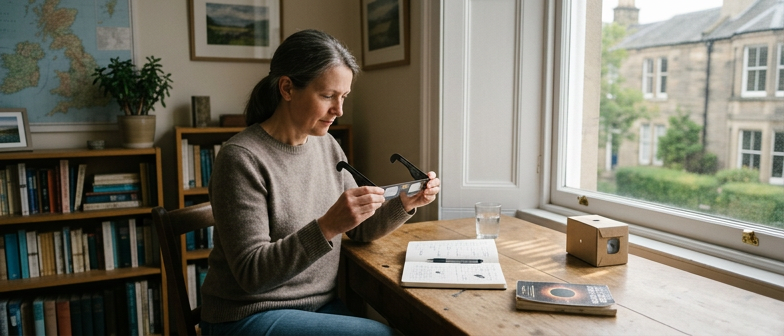
Anyone who wears prescription glasses should leave them on and place the solar viewer over the top. Before the big day, check all viewers indoors. Hold them up to a bright lamp and look for pinholes, scratches, wrinkles, or loose areas that no longer sit flat. If points of light show through or the frame feels unstable, it is safer to discard that pair.
Optical devices need even more care. Telescopes, binoculars, and cameras all concentrate light into a small area. Placing eclipse glasses in front of your face while using unfiltered optics does not protect your eyes or the equipment. Filters belong over the front of the lens system, not at the eyepiece.
For photography, many people choose dense solar filters or strong neutral‑density filters made for pointing at the sun. These reduce incoming light enough to help protect the camera sensor and allow shorter exposures.
| Viewing or imaging method | Safe practice | Risky practice to avoid | Extra notes |
|---|---|---|---|
| Naked‑eye viewing | Use certified solar viewers; inspect for damage | Using regular sunglasses or tinted glass | View only when the filter is in place |
| Binoculars / telescope | Attach a proper solar filter to the front lens | Pointing unfiltered optics at the sun, even while wearing eclipse glasses | Never look through until the front filter is secured |
| Camera or smartphone | Use a dedicated solar or dense filter over the lens | Pointing at the sun for long periods with no filter | Short, filtered exposures limit stress on the sensor |
Indirect methods that are safe by design
When suitable viewers are scarce or for very young children, indirect approaches work well. A simple pinhole projector uses a small opening to form an image of the sun on a nearby surface. The person stands with their back to the sun and looks only at the projection, never at the sun itself.
Making one can be as simple as using stiff paper or cardboard and a small pin or needle. A clean, round hole produces a sharper image. Holding a second sheet as a screen, you move it closer or farther until the tiny sun shape becomes clear.
Household items and natural patterns often act as many pinholes at once. A metal colander, slotted spoon, or a leafy tree with scattered gaps can cast an array of crescent shapes on the ground or a wall. Indirect methods like these are especially useful in groups, where supervising many people to avoid unsafe glances upward can be challenging. They do not replace certified filters for anyone who wants to look directly at the sun or capture close‑up photographs.
Making the Day a Shared Learning Moment
Building simple routines that keep groups safe
When an eclipse is visible, people often pause their usual activities and gather outside with family, classmates, or coworkers. That shared pause is a good moment to agree on a few simple habits that everyone understands.
A small “viewing station” can include a box of inspected solar viewers, a pinhole projector taped to a chair, or a patch of ground where colander or leaf shadows show up clearly. Younger children can help decorate reminder signs such as “Eyes down without filters.”
Short cues work best. Before heading out, groups can rehearse a rhythm: “Filters on, look up; filters off, look down.” Adults can model this behavior and remind anyone who starts to remove their viewer while still looking at the sky.
Turning observations into stories and questions
Once safe habits are in place, attention can shift to noticing details.
Children may be drawn to changes in color, the feel of the air, or how their own shadows look on the ground. Inviting them to sketch the scene, trace the shapes of leaf projections, or describe what they see encourages them to link observation with explanation.
Older students and adults might keep a simple log of impressions: when the light started to dim, how animals around them behaved, whether the temperature felt different, or how the horizon looked compared with an ordinary day.
Using everyday language, group members can connect those impressions back to the underlying geometry: the moon blocking sunlight, the narrow central path of the darkest shadow, and the wider zone of partial cover. Allowing people to explain these ideas in their own words—maybe as if telling a friend what they saw—turns a one‑time spectacle into a lasting memory of shared, careful curiosity.
Q&A
-
How does understanding solar eclipse mechanics improve eclipse safety and science learning?
Grasping solar eclipse mechanics clarifies why totality is brief, why the shadow path is narrow, and why the sun can still damage eyes during deep partial phases. This foundation helps people trust scientific guidance, interpret diagrams or apps correctly, and turn a dramatic sky change into a structured learning experience rather than a risky impulse event. -
What are the safest viewing methods for schools and public observation planning?
For large groups, organizers combine certified eclipse glasses, supervised telescope stations with front‑mounted solar filters, and several indirect projection setups. Staggered viewing times, clear signage, and rehearsed instructions like “filters on to look up, off to look down” reduce crowding and confusion, making safe viewing methods practical even for young children or distracted onlookers. -
How can planners explain shadow path basics to the general public?
Planners often compare the umbra to a fast‑moving spotlight sweeping across a map, with the penumbra as a broader dim zone. Simple animations, local maps showing the centerline, and times for maximum coverage help communities see why some towns get totality and nearby ones do not, supporting realistic expectations and targeted travel or event decisions. -
What role does eye protection awareness play in emergency and health messaging?
Eye protection awareness lets health officials treat eclipses like a predictable, preventable eye‑safety issue. Clear advice on certified filters, risks of improvised gear, and when it is briefly safe to look without protection limits panic after the event about normal visual fluctuations and reduces avoidable clinic visits for anxiety rather than true solar injury. -
How can educational science events make eclipses more than a one‑time spectacle?
Educational science events tie eclipse safety and science to broader themes such as orbital motion, energy from the sun, and human perception. Hands‑on activities with pinhole projection, simple shadow experiments, and post‑event reflection sessions help participants link their memories to enduring concepts, encouraging continued interest in astronomy and careful future eclipse planning.