
Soccer Conditioning Drills That Blend Sprint Recovery, Ball Control and Match Fitness
Players and coaches often feel pulled between running-based workouts and fun passing games. One day everyone is gasping after long sprints with almost no touches. Another day the ball flies around in tight spaces, but nobody feels truly pushed. Thoughtful planning can link short high efforts, realistic pauses, and quality touches so training mirrors real match rhythm.
This story is part of DailySeekers's practical reading library across everyday topics.
Escaping The “Track Day” Or “Rondo Only” Trap
Why sessions swing between two extremes
Many practice plans lean heavily in one direction. A “track style” day often means straight-line runs, repeated shuttles, and little decision-making. Players get tired, yet later struggle when real play asks for sudden turns, checks of the shoulder, and quick choices on the ball. The running does not fully match how the game actually feels.
On the other end, a “rondo only” day can be full of short passes and clever combinations. This work is valuable for touch, awareness, and confidence. Problems start when nearly every activity stays comfortable: low pressure, short distances, steady tempo. Legs and lungs rarely experience the same stress that appears during real competition.
Over time, these swings leave a gap. Players might feel technically sharp but fade during intense parts of a game, or feel fit from running yet clumsy and slow when the ball arrives. The aim is not to choose one side, but to connect both so physical stress and technical quality grow together.
Simple ways to blend running and ball work
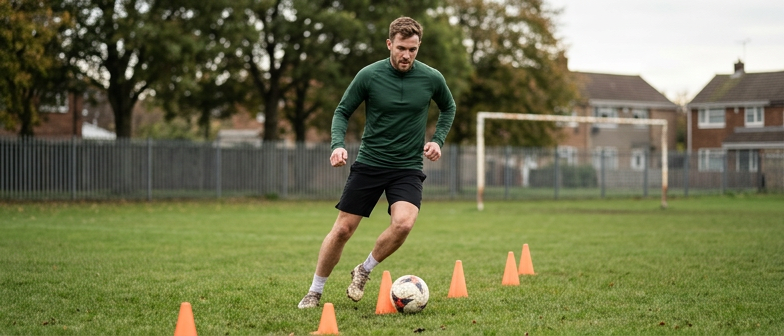
A solution is to make running patterns look more like actual play. Instead of pure sprints without the ball, use cone layouts that include diagonal moves, stops, changes of direction, and a touch at the end. Short zigzags, a feint, then a quick pass or shot can replace long, flat runs.
Rondos and tight passing games can be tuned so they create more effort. Smaller spaces increase the need to accelerate and brake. Touch limits force faster choices. Short, timed blocks with brief rests keep intensity high.
View every block on a spectrum: some segments are more about physical effort with the ball, others about precision at high speed, and only a small portion is pure running when really needed. Over several days, this balance builds a clearer link between movement, decisions, and touch.
Planning Work And Rest Around Real Match Rhythm
Designing training around the flow of play means moving away from long, steady running and toward repeated bursts with incomplete recovery. Players rarely run hard for long periods without change; instead, they bounce between sprints, jogs, walks, and short pauses.
Thinking in bursts instead of long minutes
Picture a short snapshot of play: a brief high push, then a longer period of lower activity. Practice blocks can copy this by pairing fast actions with controlled pauses. For example, a player sprints through cone gates, cuts sharply, then plays a quick one-two. After that, a short pause allows breathing to settle before repeating.
Coordination tools like agility ladders or small cone patterns also fit this burst idea. A sequence of quick steps, a hip turn, then an immediate first touch on a served ball links feet, core, and eyes. When these bursts repeat with limited breaks, conditioning and coordination rise together.
Using opponents and rules to control intensity
Small-sided games and possession activities naturally create waves of effort. Short fields increase the number of duels, sprints to close space, and quick adjustments of position. Adding a neutral player or extra goal options raises decision speed and keeps everyone involved.
To keep these games honest from a conditioning point of view, the main levers are duration, field size, and rules. Short, intense rounds with full breaks help players give maximum effort. Constraints such as one or two touches, scoring challenges, or quick restarts push the tempo.
A way to check balance is to observe technique late in a block. If movements are still reasonably clean while players show mild but clear fatigue, the work and rest relationship is likely in a helpful range.
Using Cone Grids And Small Games To “Hide” The Work
Cone layouts and small-sided play can create significant physical stress while still feeling game-related. The key is keeping every touch meaningful and every run connected to a decision.
Designing cone spaces that feel like real play
Cone grids are most useful when they create familiar soccer pictures. A rectangle where shorter sides support combination play and longer sides allow runs in behind is one flexible option. Inside this grid, formats like 2v2 or 3v2 can encourage constant movement.
Extra rules can lift workload without announcing that the group is “doing fitness.” Requiring the receiving player to move into a new channel after every pass, or insisting that certain zones allow only one touch, forces constant repositioning. Adding a neutral player keeps possession flowing and increases the number of decisions each player faces.
| Grid Feature Or Rule | Main Effect On Players | When It Is Most Useful |
|---|---|---|
| Smaller overall space | More continual accelerations and decelerations | Emphasising sharp reactions and tight control |
| Larger but narrow space | More repeated forward and backward runs | Working on recovery runs and tracking opponents |
| One-touch in key zones | Faster decisions, higher mental load | Preparing for pressure near goal or in midfield pockets |
Turning small-sided formats into structured conditioning
Small-sided play becomes a conditioning tool when engagement stays high for everyone. Formats like 3v3 or 4v4 with mini goals or end zones create repeated sprints to win the ball, support the attack, or recover.
Progressions can layer extra strain while keeping the main game intact. One group might complete a short passing pattern through cones, then instantly join a small game to goal. Players rotate out after a brief, intense spell, catch their breath, then re-enter. Another twist is a side channel hosting rapid 1v1 duels; players move between this channel and the central game, mixing strength, acceleration, and decision-making.
Because the main focus is still the ball and opponents, players often perceive the block as a competitive game first and only notice the physical demand afterward, which can help with motivation and buy-in.
Putting Flows Together And Balancing Overall Load
The final step is linking warm-up, main work, and the final few minutes into a coherent plan that suits the group’s schedule, age, and match demands.
From warm-up to main work
An effective start usually follows a gentle build. Light movement, mobility for key joints, and short activation drills prepare muscles and nervous system without draining energy. Incorporating basic passing and receiving helps players switch on mentally while still in a low-stress zone.
A short, focused keep-ball or rondo in a modestly tight space then connects readiness with awareness. The length of this block stays limited so players do not arrive at the main segment already tired. The goal is to step into harder work feeling loose, alert, and technically settled.
The main section then targets a clear aim: repeated high bursts, more continuous running within games, or a blend matched to upcoming demands. Running-based drills can be integrated with touches at the beginning or end of each sprint, while game-based blocks rely on rules and pitch design to drive intensity.
| Session Element | Relative Intensity | Key Check Before Moving On |
|---|---|---|
| Initial warm-up and mobility | Low | Breathing slightly raised, movements smooth and relaxed |
| Activation and first ball work | Low to moderate | Touch quality stable, no visible fatigue |
| Main high-focus block | Moderate to high | Technique still acceptable near the end of rounds |
| Final low-intensity phase | Very low | Heart rate clearly dropping, players able to talk comfortably |
Cooling down and adjusting future plans
The closing phase shifts back to low-intensity movement: easy passing, light jogging, and relaxed stretching help the body transition out of higher effort. Calm breathing and a brief check-in on how hard the work felt give useful feedback.
Over multiple practices, notes on player reactions, body language, and execution levels guide small adjustments. If players struggle to keep quality late in blocks, work intervals might be shortened or rests slightly extended. If they appear fresh and sharp even at the end, a gradual increase in intensity or density can be considered.
By repeatedly linking short sprints, frequent changes of direction, and precise touches within a shaped plan, training begins to mirror the demands of real contests more closely. The goal is not endless effort, but the ability to produce key actions at quality again and again when it matters.
Q&A
-
How can Soccer Conditioning Drills better reflect real match fitness demands?
Well-designed soccer conditioning drills should blend directional changes, ball contacts, and decision making within short work blocks. Instead of straight-line running, players combine turns, checks, and passing under realistic pressure. This approach improves aerobic capacity, repeated sprint ability, and technical sharpness at game speed without feeling like isolated track work. -
What is an effective way to structure Sprint Recovery Intervals in soccer training?
Sprint recovery intervals should mirror match bursts: sharp accelerations of 3–6 seconds followed by incomplete recovery using light jogging or technical tasks. Coaches can cycle work-to-rest ratios like 1:3 or 1:4, gradually shortening rest across weeks. Including quick passes or finishes at each sprint’s end keeps conditioning tightly connected to soccer actions. -
How can Ball Control Movement be integrated into Endurance Session Planning?
Endurance sessions can rotate between ball control movement blocks and low-intensity possession phases. Players perform sequences involving tight touches, directional changes, and quick releases, then transition into calmer keep-ball to recover. Repeating this pattern builds the capacity to maintain first touch and composure while fatigued, which is crucial in later stages of competitive matches. -
What principles make Agility Cone Work relevant for Match Fitness Basics?
Agility cone work supports match fitness when patterns mimic common game actions, such as closing down, recovering, and supporting play. Short routes with hip turns, diagonal shuffles, and backward movements prepare joints and coordination. Adding a pass, shot, or duel at the final cone links agility to realistic decisions and improves transfer from training ground to game. -
How should coaches manage Training Load Balance across a busy week?
Training load balance starts with planning heavy, mixed-intensity days away from matches and lighter, sharper sessions near game day. Coaches track volume, intensity, and player responses, alternating demanding conditioning work with more tactical or technical focus. Using small-sided games, controlled intervals, and clear objectives helps avoid both underloading and excessive fatigue.